

Audit Ready: How to Create a Living Welding Doc System
Compliance isn’t a hurdle to clear once a year; it’s a constant state of operational readiness that many organizations fail to maintain. You’ve likely experienced the frantic scramble weeks before an inspector arrives, trying to reconcile fragmented spreadsheets and locate expired welder certificates. Transitioning From Audit Panic to Audit Ready: How to Make Welding Documentation a Living System requires moving away from these reactive, manual habits. In a GMP environment, which refers to Good Manufacturing Practice standards requiring rigorous documentation and traceability to ensure product safety, a disorganized paper trail is a significant regulatory risk. Recent industry data shows that approximately 60% of GMP inspection findings in 2026 are linked to data integrity and documentation control issues.
We understand that your time as a Welding Coordinator or Quality Manager is better spent on technical oversight than on manual log generation. This article outlines how to move from chaotic, fragmented records to a structured, living documentation system. You’ll learn how to maintain real-time visibility over your projects, making compliance for ISO 3834 and EN 1090 provable and stress-free. We will examine the practical steps to implement a digital framework that supports your compliance goals and reduces the risk of non-conformance findings during your next audit.
Key Takeaways
- Learn the transition From Audit Panic to Audit Ready: How to Make Welding Documentation a Living System by moving from reactive archives to proactive, real-time data collection.
- Understand why fragmented spreadsheets create unacceptable regulatory risks in GMP environments, which require rigorous documentation and traceability to ensure product safety.
- Identify how digital tools support compliance with ISO 3834 and EN 1090 by providing structured, auditable records that are consistently maintained.
- Discover practical steps to standardize welding log workflows and centralize qualification records to reduce time spent on manual administrative tasks.
- Recognize that software is a support tool that makes compliance provable, rather than a physical control or a guarantee of error-free production.
The Cost of Documentation Gaps in GMP Environments
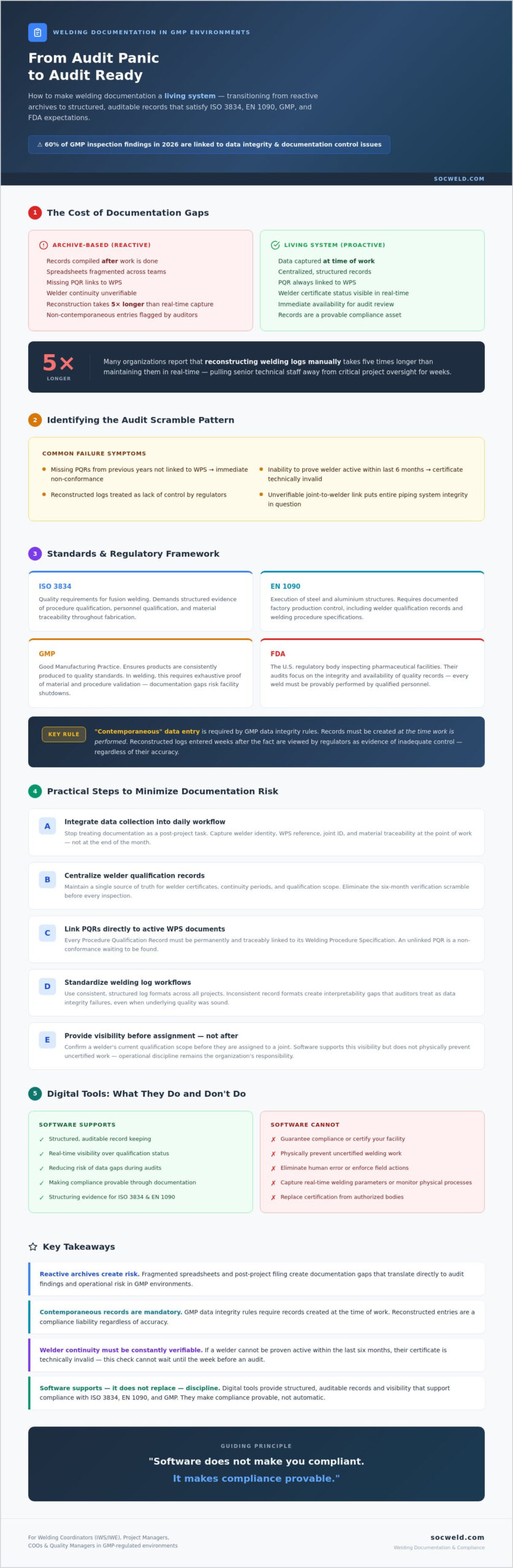
The “audit scramble” isn’t an isolated event. It’s the inevitable result of using fragmented, archive-based record keeping. When documentation is treated as a post-project task rather than an integrated workflow, gaps are guaranteed to occur. In pharmaceutical production, these gaps translate directly to operational risk. Transitioning From Audit Panic to Audit Ready: How to Make Welding Documentation a Living System requires recognizing that static spreadsheets cannot meet the demands of modern oversight.
GMP, or Good Manufacturing Practice, is a system for ensuring products are consistently produced and controlled according to quality standards, which in welding requires exhaustive proof of material and procedure validation. Compliance here is closely monitored by the FDA. The Food and Drug Administration (FDA) is the regulatory body that inspects pharmaceutical facilities to ensure they meet quality management standards; their audits focus heavily on the integrity and availability of quality records to prove every weld was performed by qualified personnel. Recent data indicates that 60% of GMP inspection findings in 2026 are now tied to data integrity and documentation control issues. If your records aren’t ready, your facility’s operational status is at risk.
Identifying the Audit Scramble Pattern
The most common symptom of a failing system is the last-minute search for missing Procedure Qualification Records (PQR) from previous years. When these documents aren’t linked to a specific Welding Procedure Specification (WPS), an immediate non-conformance finding often follows. We’ve seen organizations struggle with uncertainty regarding welder continuity. If you can’t prove a welder has been active within the last six months, their certificate is technically invalid. The administrative burden of manually verifying these welding compliance markers is high. It often pulls senior technical staff away from critical project oversight for weeks at a time.
The Regulatory Impact: GMP and FDA Expectations
Fragmented traceability fails because it lacks the “contemporaneous” element required for data integrity. Records must be created at the time the work is performed. When a quality manager tries to reconstruct a welding log months after the project ended, the risk of data entry errors increases. Regulators view these delays as a lack of control. If an inspector cannot verify the link between a welder’s qualification and a specific joint, the integrity of the entire piping system is called into question. Many organizations report that reconstructing logs manually takes five times longer than maintaining them in real-time.
Poor documentation quality is more than a clerical error; it’s a direct link to the risk of a facility shutdown. A living system ensures that data is captured as it happens, providing the structured, auditable records that satisfy both ISO 3834 and EN 1090 requirements. While software doesn’t physically control the weld, it provides the visibility needed to ensure that only qualified personnel are assigned to the task. This proactive approach is exactly what auditors look for during a high-stakes inspection, turning documentation from a liability into a provable asset.
From Archival Paperwork to a Living Documentation System
Traditional welding documentation is often reactive. It relies on a “filing” mindset where records are compiled after the work is finished. This creates a static archive that’s frequently incomplete or out of date. Transitioning From Audit Panic to Audit Ready: How to Make Welding Documentation a Living System requires a fundamental shift. You must integrate data collection into the daily workflow of every project. Instead of chasing papers at the end of the month, information should be captured as it’s generated.
A living system is proactive. It moves beyond simple storage and creates a modern welding documentation framework that is always current. In a GMP environment, where documentation gaps can lead to facility shutdowns, this distinction is critical. By treating records as structured data rather than physical or digital “paper,” you ensure that compliance is a byproduct of your work, not a separate task.
Why Spreadsheets Fail the Traceability Test
Spreadsheets are often the first tool companies use, but they fail to provide true traceability. The lack of version control is a major risk. It’s common for conflicting versions of a WPS to circulate on the shop floor because a master file wasn’t properly updated. Manual entry is also prone to transcription errors. A single mistyped welder ID can undermine the credibility of an entire audit. Adhering to AWS Codes & Standards requires a level of accuracy that spreadsheets simply cannot maintain without extreme administrative effort.
Spreadsheets also lack automated alerts. They won’t notify you when a welder’s certificate is about to expire or when a continuity record is missing. This forces Quality Managers into a cycle of manual checks that waste significant time. Many organizations report that these manual processes are the primary cause of pre-audit stress. Relying on a system that requires constant human verification is an inefficient way to manage risk.
Designing for Constant Audit Readiness
Designing for readiness means centralizing all certificates, WPS, and logs in a single digital environment. This provides total visibility. You should be able to see the status of every weld and every welder at any moment. Real-time updates eliminate the need for “pre-audit” cleanup weeks. When the auditor asks for a specific record, it’s already there, verified and linked to the project. This level of organization is essential for maintaining the auditable state required by international standards.
A digital welding documentation platform supports this level of discipline by providing a structured environment for data entry. It ensures that the required fields are filled out correctly the first time. This visibility allows Project Managers to spot potential documentation gaps before they become non-conformance findings. In the end, a living system makes compliance provable without the need for a last-minute scramble.
Structured Evidence: Navigating ISO 3834 and EN 1090
Compliance with ISO 3834 and EN 1090 is not a one-time achievement. It is a continuous requirement for proof of planning, qualification, and inspection. These standards demand that every weld be backed by documented evidence that the procedure was correct and the welder was certified. Transitioning From Audit Panic to Audit Ready: How to Make Welding Documentation a Living System means moving away from disorganized binders toward a digital framework that structures this evidence automatically. While software won’t achieve compliance for you, it provides the auditable trail necessary to prove your state of compliance to third-party inspectors.
Traceability serves as the golden thread in any quality system. It links the base material, the specific welder, and the approved procedure into a single, verifiable record. In high-stakes industries, documentation gaps are often the difference between a successful project and a costly non-conformance finding. This level of rigor is mirrored in other regulated sectors, such as aerospace, where the FAA welding repair guidance emphasizes that without proper documentation, the physical quality of the work cannot be validated.
Supporting Compliance Through Data Consistency
A living documentation system supports compliance by ensuring every weld log references a qualified WPS and a valid welder certificate. It eliminates the risk of “lost” inspection reports by allowing for immediate digital capture at the source. For Welding Coordinators (IWS/IWE), this structure facilitates faster review cycles. Instead of manually cross-referencing paper logs against certificate expiration dates, coordinators can view a live project overview. Many organizations report that this visibility reduces the time spent on administrative verification by nearly 50%, allowing technical experts to focus on weld quality rather than paperwork.
The GAMP5 Framework for Digital Systems
In the pharmaceutical sector, digital tools must also align with GAMP5. GAMP5, or Good Automated Manufacturing Practice version 5, is a risk-based framework for compliant GxP computerized systems. It ensures that software is fit for purpose and maintains data integrity throughout the record lifecycle. When selecting a digital welding documentation platform, it’s essential to ensure the tool supports these principles.
A GAMP5-aligned approach focuses on the reliability of the records. This means the system must provide a clear audit trail of who entered the data and when. It doesn’t physically prevent uncertified work, but it provides the visibility needed to identify and address risks before they reach the final quality report. By using software that respects these data integrity standards, you ensure that your welding records are as robust as the pharmaceutical products they support. Structured records turn compliance from a burden into a provable asset.
Practical Steps to Minimize Documentation Risk
Transitioning From Audit Panic to Audit Ready: How to Make Welding Documentation a Living System relies on a disciplined, standardized approach to data entry. It’s not enough to have the right documents; those documents must be linked and accessible. Minimizing risk starts with ensuring that data is captured at the source rather than being reconstructed from memory weeks later. In a GMP environment, where documentation must be contemporaneous to be valid, this shift is essential for maintaining a state of audit readiness.
Standardization removes the ambiguity that leads to non-conformance. When every project follows the same data entry protocol, the risk of missing information decreases. Many organizations report that moving toward automated, structured records significantly reduces the administrative burden on Quality Managers. By implementing a system that supports compliance through structure, you ensure that the evidence required for ISO 3834 and EN 1090 is always at your fingertips.
Standardizing the Welding Log Workflow
Moving from paper-based site notes to direct digital entry is a critical first step. This prevents transcription errors and ensures that records are created at the time the work is performed. Each weld ID should be linked to specific isometric drawings and material heat numbers within your system. This creates a clear path for traceability that auditors can follow without confusion. Additionally, linking NDT (Non-Destructive Testing) results directly to the corresponding weld record ensures that no weld is left unverified. These links form the “golden thread” of documentation that proves the integrity of your production process.
Managing Welder Certificates and Continuity
A common point of failure in high-stakes audits is the use of welders whose certificates have lapsed or who aren’t qualified for a specific range. You should implement a central repository that maintains a live database of welder skills and qualified ranges. Setting up automated notifications for certificate renewals allows you to address expiration before it becomes a project bottleneck. This proactive management ensures you don’t assign uncertified work to a project. While software doesn’t physically stop an uncertified welder from working, it provides the visibility needed for Welding Coordinators to make informed staffing decisions.
A digital welding documentation platform supports this discipline by providing a structured environment where these links are established by default. It allows for automated welding log generation, which provides the auditable evidence needed for project deliverables. By standardizing these workflows, you ensure that compliance remains provable throughout the project lifecycle.
Supporting Discipline with Digital Welding Documentation
Transitioning From Audit Panic to Audit Ready: How to Make Welding Documentation a Living System is as much about professional discipline as it is about technology. Software serves as a support tool that structures your evidence, but it cannot replace the technical expertise of a Welding Coordinator. By adopting a digital platform, you move away from the physical clutter of spreadsheets and toward a system that reduces risk through organization. Digital welding documentation software should be viewed as the natural conclusion to a company’s need for operational efficiency and risk mitigation.
The move to a digital environment is not merely about replacing paper; it is about creating a framework where compliance is a constant state. Many organizations report significant time savings when welding logs are generated automatically from structured data. This efficiency allows Quality Managers to focus on high-level oversight rather than manual data entry. However, it’s vital to remember that software is a repository for documentation, not a physical control mechanism. It provides the visibility needed to maintain standards, but the responsibility for quality remains with the technical team.
How Software Makes Compliance Provable
It is important to clarify that software provides visibility into your documentation status but does not control the welding arc. It does not physically prevent uncertified work from occurring on the shop floor. Instead, it highlights documentation gaps, such as expired certificates or missing WPS links, before they become audit findings. You must also distinguish between the certification provided by authorized bodies and the software used to manage those records. The software supports the auditable state; it does not grant compliance itself.
During a high-stakes audit, the value of a “single source of truth” cannot be overstated. When an inspector asks for a specific welder’s continuity record or a PQR, having that data linked and instantly accessible builds confidence. Fragmented systems often lead to conflicting data, which signals a lack of control to regulators. A digital platform ensures that the evidence you present is consistent, structured, and easy to verify, fulfilling the core requirement that compliance must be provable through records.
Transitioning to a Structured Digital Environment
When evaluating digital welding documentation software, focus on your specific regulatory needs, such as GAMP5 requirements for data integrity. GAMP5 refers to a risk-based approach for compliant GxP computerized systems, ensuring that software is fit for its intended use in regulated pharmaceutical environments. Success in this transition depends more on implementation and team discipline than on specific software features. A tool is only as effective as the data entered into it.
Ultimately, the goal of a living system is to move from a reactive “scramble” to a proactive state of readiness. This requires a commitment to capturing data at the source and maintaining it with the same rigor applied to the welding itself. Software does not make you compliant. It makes compliance provable. As you evaluate your current processes, consider this: Is your current documentation a burden to carry or a shield to protect your business?
Establishing a State of Permanent Audit Readiness
Maintaining a state of constant readiness requires moving away from the annual audit scramble and toward a system that captures data as work occurs. By integrating documentation into your daily project workflow, you ensure that traceability is a byproduct of your activity rather than a separate administrative burden. Moving From Audit Panic to Audit Ready: How to Make Welding Documentation a Living System is the most effective way to safeguard your facility against the high cost of non-conformance findings in GMP environments.
SOCWeld provides a digital platform designed for high-compliance industries. Many organizations report that it reduces administrative time on welding logs by replacing manual spreadsheets with automated, auditable records. These structured records support your evidence for ISO 3834 and EN 1090, giving you a clear project overview during high-stakes inspections. You can explore how SOCWeld supports your audit readiness to see how digital tools simplify compliance management.
Ultimately, the strength of your quality system depends on the discipline of your documentation. Software does not make you compliant; it makes compliance provable. Is your current documentation a burden to carry or a shield to protect your business?
Frequently Asked Questions
Does welding documentation software guarantee ISO 3834 compliance?
Software does not guarantee compliance; it serves as a tool that supports the auditable state required by standards like ISO 3834. Compliance is a state maintained by your organization’s internal discipline and processes, while certification is granted only by authorized bodies after an audit. The software provides the structured evidence needed to make your compliance provable during an inspection.
How does digital documentation support GMP requirements in pharma?
Digital tools support GMP requirements by improving data integrity and ensuring records are created contemporaneously. GMP (Good Manufacturing Practice) refers to the regulatory standards that ensure pharmaceutical products are consistently produced and controlled according to quality levels. By replacing fragmented spreadsheets with a centralized platform, a digital system reduces the risk of documentation gaps that often lead to audit findings.
Can software prevent a welder with an expired certificate from working?
No, the software does not physically control the shop floor or prevent uncertified work from occurring. It provides visibility through automated alerts and real-time project overviews, allowing Welding Coordinators to identify risks before work begins. The responsibility for enforcing site discipline and ensuring certificate validity remains with the management team; the software simply makes the data visible.
What is the difference between a “static archive” and a “living system”?
A static archive is a reactive collection of records compiled after a project is finished, which often leads to missing or inaccurate data. A living system integrates documentation into the daily workflow, capturing data at the source as it’s generated. Transitioning From Audit Panic to Audit Ready: How to Make Welding Documentation a Living System requires this proactive shift to ensure records are always current and auditable.
How much time can a digital welding log system actually save?
Many organizations report significant time savings when they move away from manual administrative tasks and physical record-keeping. By automating welding log generation and centralizing certificate management, technical staff spend less time on clerical reconciliation. This allows Welding Coordinators and Quality Managers to focus their expertise on technical oversight and risk mitigation rather than chasing missing signatures or certificates.
Is digital welding documentation acceptable for FDA and GAMP5 audits?
Yes, digital documentation is acceptable provided the system supports data integrity principles and is properly validated. The FDA (Food and Drug Administration) conducts audits that focus heavily on the integrity and availability of quality records. GAMP5 (Good Automated Manufacturing Practice) is a risk-based framework for compliant computerized systems, ensuring they’re fit for purpose in regulated environments. A structured platform helps provide the auditable trail these bodies expect.
What happens to my historical paper records when I switch to digital?
Historical records typically remain in their original format as part of your legacy archive for the required retention period. Most organizations use digital systems for new and ongoing projects to establish a structured, auditable trail moving forward. This allows you to phase out manual methods while maintaining a clear distinction between legacy files and your new, more efficient documentation system.
Does the software capture real-time welding parameters like voltage and current?
No, digital welding documentation software focuses on documentation-level traceability, such as welder certificates, WPS links, and weld identifiers. It does not involve the physical monitoring of welding equipment or the capture of real-time parameters like voltage or current. The scope is strictly limited to managing the records and evidence required for project deliverables and compliance audits.
Related Resources
Ready to modernize your welding documentation? Start with a free online assessment to see where your process stands today.