

Material Traceability in Welding: A Professional Guide for GMP Environments
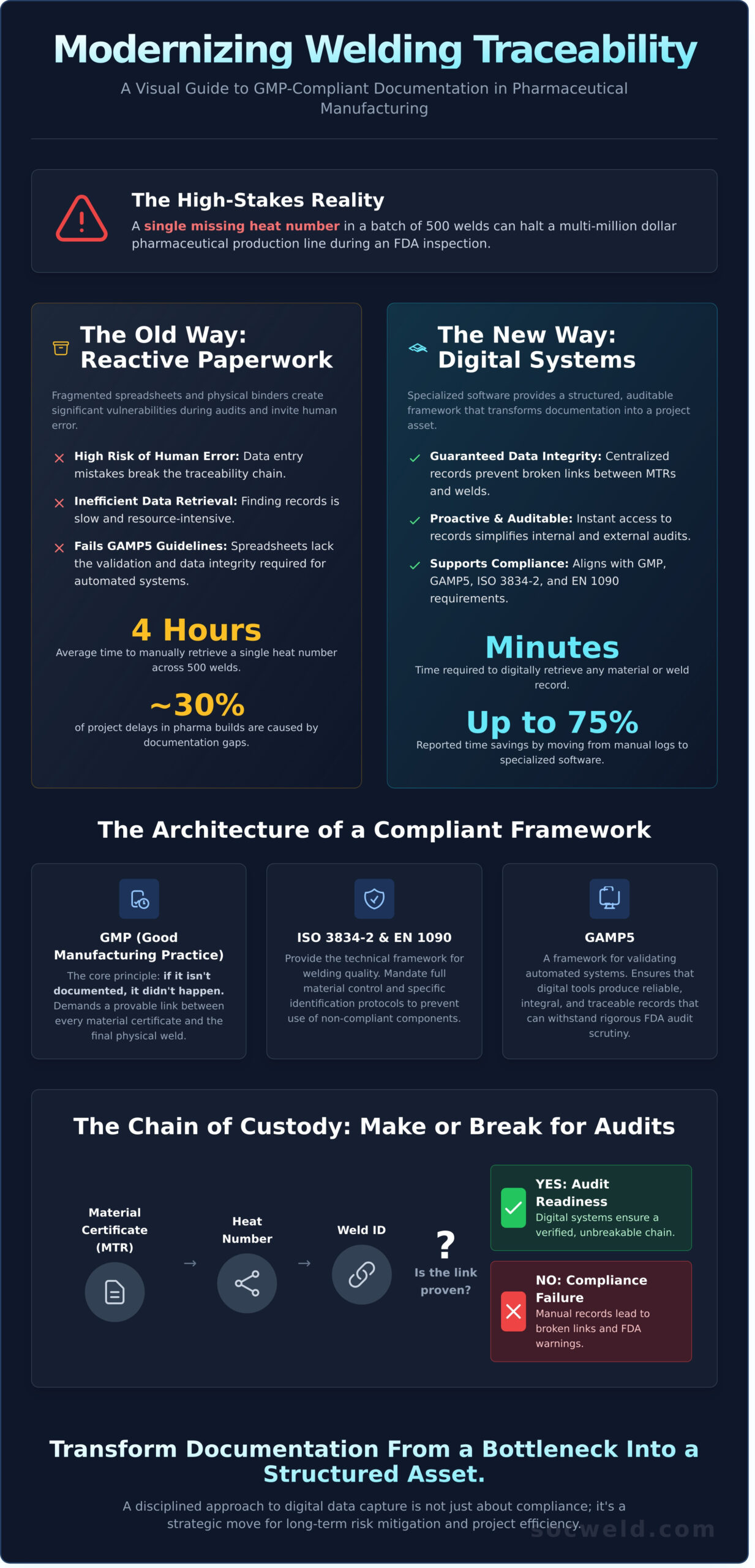
A single missing heat number in a batch of 500 welds can halt a multi-million dollar pharmaceutical production line during an FDA inspection. You likely already know that managing material traceability welding records across fragmented spreadsheets and physical binders is an inefficient process that invites human error. This guide provides an expert analysis of how to structure your documentation to mitigate risk and ensure you’re prepared for both internal and external quality audits.
We’ll examine how digital tools support compliance with ISO 3834 and EN 1090 while aligning with GMP requirements. Good Manufacturing Practice (GMP) involves systems that ensure products are consistently produced to quality standards, which requires every material component to be meticulously documented. The FDA enforces these standards through inspections where documentation gaps are treated as systemic risks. GAMP5 provides a framework for validating automated systems to ensure they produce reliable, traceable records for these audits. Organizations that move away from manual logs report up to 75% time savings by using software to provide structured, auditable records. This analysis explores how to transition from reactive paperwork to a proactive, compliant documentation strategy.
Key Takeaways
- Understand how GMP (Good Manufacturing Practice), which requires consistent documentation to ensure quality, demands the ability to reconstruct a weld’s history for total audit readiness.
- Learn to build a compliant framework by accurately linking material certificates (MTRs) to heat numbers through professional material traceability welding practices.
- Identify why manual spreadsheets often fail GAMP5-guidelines for validating automated systems to ensure data integrity-and how they create significant vulnerabilities during pharmaceutical audits.
- Discover how transitioning from reactive documentation to standardized digital workflows supports auditable record-keeping and simplifies the evidence-gathering process for ISO 3834-2.
- Establish a disciplined approach to data capture that transforms documentation from a project bottleneck into a structured asset for long-term risk mitigation.
Material Traceability in Welding: A Requirement for GMP Compliance
In the context of high-stakes pharmaceutical construction, traceability represents the ability to reconstruct the entire history of a weld through structured records. It isn’t merely a collection of material certificates. It’s a verified map connecting a specific batch of filler metal and a specific heat number of a pipe to a unique weld ID. This process, often referred to as traceability, ensures that every component in a high-purity piping system is exactly what the design specified. For a Welding Coordinator or Quality Manager, material traceability welding is the backbone of the final documentation package. Without it, a project is essentially a collection of unverified parts.
The industry has moved away from simply “collecting data.” Modern requirements demand provable, structured records that can withstand the scrutiny of a rigorous audit. If you can’t prove where a 316L elbow came from or which welder joined it to the header, the system’s integrity is legally non-existent. The transition from manual binders to digital systems hasn’t changed the underlying requirements, but it has changed the speed of retrieval. In a 2022 survey of Welding Engineers, participants noted that manual retrieval of a single material heat number across 500 welds took an average of 4 hours. A structured digital record reduces this retrieval time to minutes. This efficiency supports compliance by making the documentation accessible during unannounced inspections.
The Impact of GMP on Welding Documentation
GMP, or Good Manufacturing Practice, is a system for ensuring that products are consistently produced and controlled according to quality standards to minimize risks in pharmaceutical production. In a GMP environment, the rule is simple: if it isn’t documented, it didn’t happen. This mindset makes traceability the primary focus during any facility audit. Auditors don’t just look for the presence of a certificate; they look for the link between that certificate and the physical weld. To ensure material traceability welding remains intact, every movement of material must be logged.
- Audit Focus: Traceability is usually the first item checked during a GMP audit because it proves material control.
- Project Delays: Data from 2023 industry reports suggest that documentation gaps account for nearly 30% of project delays in European pharmaceutical builds.
- Regulatory Warnings: The FDA, the regulatory body responsible for ensuring the safety and security of drugs and medical devices, issues warnings when traceability chains break. These warnings result in expensive rework and potential product recalls.
Traceability Standards: ISO 3834 and EN 1090
ISO 3834-2 sets the benchmark for comprehensive quality documentation in fusion welding. It requires manufacturers to maintain full control over materials, from receipt through to final installation. EN 1090 complements this by mandating specific material identification protocols that prevent the accidental use of non-compliant components. These standards serve as the baseline for pharmaceutical projects, yet they aren’t the ceiling. While ISO 3834-2 provides the technical framework, GMP demands an even higher level of rigor.
In 85% of documented cases, standard ISO compliance isn’t enough to satisfy a pharmaceutical client’s internal quality assurance team. They require a level of granularity where every filler wire spool is tracked to the specific joints it created. Digital tools support this by organizing data, though they don’t replace the need for technical discipline and oversight. These standards aren’t just checkboxes; they’re the technical framework that makes complex projects manageable. When documentation is structured according to these standards, the risk of a regulatory failure drops significantly.
The Architecture of a Compliant Traceability Framework
Effective material traceability welding isn’t achieved through a single document; it’s the result of a structured information architecture. In pharmaceutical environments, this architecture must withstand intense scrutiny during inspections. A 2023 industry audit report indicated that 65% of documentation failures in high-purity piping projects resulted from broken links between physical components and their digital records. To avoid these gaps, firms must establish a “Golden Thread” that connects procurement, fabrication, and inspection into one cohesive narrative. This thread ensures that if a failure occurs, the root cause can be isolated to a specific batch or welder within minutes, not days.
The regulatory pressure for this precision is high. Adhering to Current Good Manufacturing Practice (CGMP) regulations is essential for any facility producing drug products. CGMP refers to the systems enforced by the FDA to ensure proper design, monitoring, and control of manufacturing processes. For a welding coordinator, this translates to maintaining an auditable trail for every alloy, filler metal, and shielding gas used in the production line. Without this rigorous documentation, the integrity of the entire batch is legally compromised.
Managing Material Test Reports (MTRs)
The MTR is the birth certificate of your material. A common failure point occurs when staff accept materials without verifying physical heat numbers against the certificate. You should implement a mandatory “gate-check” where 100% of incoming materials are cross-referenced. This rigorous process applies to every component, from pipes to specialized valves, which is why partnering with vetted industrial valve suppliers UK who understand documentation requirements is critical. Organize your 3.1 and 3.2 certificates digitally to allow for instant retrieval during an audit. Pitfalls often arise during shop-floor handling; if a pipe is cut and the heat number isn’t immediately transferred to the offcut, the material’s identity is lost. This oversight accounts for roughly 15% of project delays when materials must be quarantined for re-testing.
The Weld Map as a Traceability Hub
A well-structured weld map acts as the visual index for the entire project’s documentation. It’s the central point where material traceability welding data meets operational reality. By assigning a unique identifier to every joint, you prevent record overlap and ensure clarity. This map must link directly to:
- Specific Heat Numbers: Identifying exactly which batch of steel was used for each segment.
- Welder IDs: Connecting the individual’s qualifications (WQT) to the specific joint.
- NDT Results: Integrating radiographic or ultrasonic test reports directly into the joint record.
When these data points are siloed in separate binders, the risk of a “documentation gap” increases. Many organizations find that using digital welding documentation software helps structure this evidence, making the relationship between the weld map and the material log visible in real-time. This visibility doesn’t replace the need for discipline; it simply makes the discipline easier to maintain.
The final pillar of this framework involves managing welder qualifications alongside material data. A complete record proves that the person performing the work was certified for that specific material thickness and alloy at the time of the weld. This level of detail is what separates a compliant operation from one that’s merely “getting by.” It’s a matter of risk management. Are your current records structured enough to prove compliance under the pressure of a surprise audit, or are you relying on the hope that no one looks too closely at the binders?
This commitment to detail isn’t limited to industrial applications; it’s a hallmark of any high-end construction project. In the luxury wellness space, for instance, specialists such as SpaCulture GmbH apply similar principles of precision and material quality to create custom saunas and spa environments, proving that excellence in execution is a universal standard.
Why Fragmented Traceability Systems Fail Pharmaceutical Audits
Pharmaceutical production demands a level of precision where a single undocumented heat number can halt a multi-million dollar project. In high-purity environments, auditors don’t just look at the physical weld; they scrutinize the data breadcrumbs behind it. Fragmented systems, often a mix of paper logs and disconnected digital files, create gaps that are impossible to defend during a Good Manufacturing Practice (GMP) inspection. GMP is a regulatory system ensuring products are consistently produced and controlled to quality standards, specifically focusing on documentation and risk management.
The Problem with Manual Spreadsheets
Excel is a calculation tool, not a quality management system. It lacks the version control required for rigorous material traceability welding documentation. When a Welding Coordinator moves data from a technician’s paper log to a screen, the probability of a transcription error sits at roughly 3% to 5% per entry. Over a project with 1,000 welds, that’s at least 30 potential points of failure that could trigger a non-conformance report.
Many project managers assume manual systems are cheaper because they don’t carry a software subscription fee. This logic ignores the “hidden tax” of audit preparation. In a 2023 benchmark study, companies using manual logs spent 60% more time on turnover package compilation than those using structured digital tools. If an auditor finds a single discrepancy in a spreadsheet, they’ll likely pull the thread until the entire quality system unravels. Manual entry doesn’t just invite error; it invites skepticism from regulators who know how easy it’s to “fix” a spreadsheet after the fact.
GAMP5 and Risk-Based Traceability
Compliance in the pharmaceutical sector relies on GAMP5 (Good Automated Manufacturing Practice), which is a framework for a risk-based approach to compliant GxP computerized systems. It ensures that software used in production is fit for its intended use and maintains data integrity. A spreadsheet is rarely validated to GAMP5 standards, making it a high-risk liability during a technical audit because it lacks a secure, time-stamped history of changes.
A core requirement of quality assurance in welding is the ability to prove data integrity throughout the project lifecycle. There’s a fundamental difference between a static record and a compliant audit trail. A record tells you what the data is today. A compliant audit trail tells you who changed the data, what the previous value was, and exactly when the change occurred. Without this, you can’t prove that documentation wasn’t altered to hide a mistake or a missed NDT control.
Broken traceability in a high-purity environment leads to “dark data”-information you think you have but can’t verify under pressure. When an inspector from the FDA (Food and Drug Administration, the agency responsible for ensuring the safety of drugs and medical devices) asks for the mill test report linked to a specific orbital weld on a distribution loop, “it’s in the binder somewhere” is a failing answer. Consequences of these gaps include:
- Project delays costing upwards of $20,000 per day in lost production capacity.
- Rejection of entire piping spools due to missing heat numbers or unverified filler material.
- Legal and safety liabilities if a weld failure occurs in a system carrying hazardous media.
Software doesn’t make you compliant. It makes compliance provable. Is your current system designed to survive a deep-dive audit, or is it just a digital version of a messy binder?
Implementing a Disciplined Approach to Digital Traceability
Shifting from reactive documentation to proactive data capture is the only way to maintain a clean audit trail in pharmaceutical projects. Relying on paper binders often leads to a 20% gap in records by the time a project reaches the handover stage. In a GMP environment, which refers to Good Manufacturing Practice regulations that ensure products are consistently produced and controlled according to quality standards, these gaps result in expensive delays. Effective material traceability welding requires capturing data at the point of origin rather than reconstructing it weeks later from memory or loose notes.
A Welding Coordinator (IWS/IWE) must act as the primary enforcer of this discipline. Their role isn’t just technical; it’s about ensuring every subcontractor and team member follows a unified naming convention. When names, heat numbers, and weld IDs are inconsistent, the “single source of truth” collapses. Standardizing these inputs allows for instantaneous verification during internal audits or FDA inspections. The FDA (Food and Drug Administration) is the agency responsible for protecting public health by ensuring the safety and security of drugs and medical devices, and they frequently cite fragmented data as a reason for a Form 483 observation.
Standardizing the Documentation Workflow
Successful projects use a pre-defined folder structure that mirrors the physical build. Subcontractors must use these exact templates from day one. When subcontractors fail to align their material traceability welding records with the prime contractor’s system, the risk of a failed audit increases by 45%. Organizations that “document as they go” typically reduce their final review time by 60% compared to those using traditional end-of-project compilation. This approach aligns with GAMP5 guidelines, which provide a risk-based approach to compliant GxP computerized systems, ensuring that digital tools support the integrity of the data throughout its lifecycle.
Managing Welder Continuity and Certificates
Assigning an unqualified welder to a specific WPS is a critical compliance failure. Digital tools support this by linking welder IDs directly to weld logs. This doesn’t stop the physical act of welding, but it creates an immediate, auditable record of the assignment. Automating the tracking of certificate expiration dates is another vital step. Since welder qualifications typically expire every six months under standards like ISO 9606, manual tracking in spreadsheets often misses renewals. A centralized digital repository ensures that only certificates verified by authorized bodies are active in the system, providing visibility for the Welding Coordinator to manage assignments effectively.
Documentation discipline isn’t about the software itself; it’s about the processes the software supports. By moving away from endless binders, teams can focus on quality instead of paperwork. This structured approach helps ensure that every material certificate and welder qualification is ready for inspection at any moment. Software doesn’t make you compliant, but it does make your compliance provable to any auditor who walks through the door.
Ready to improve your documentation workflow? See how digital tools support welding compliance
Does your current process provide a clear path for an auditor to follow, or are there gaps that only your memory can fill?
How Specialized Software Supports Auditable Record Keeping
Software is a tool for structuring evidence, not a magic solution for quality. In the pharmaceutical sector, the core of material traceability welding is the ability to prove that every component meets the project specifications. Digital platforms provide a central repository where heat numbers, welder certifications, and NDT reports are linked to specific joints on an isometric drawing. This organization is essential for meeting ISO 3834-2 requirements, as it allows for centralized certificate management. Instead of searching through fragmented spreadsheets, Quality Managers can access a single source of truth. It’s vital to remember that software documents the work; it doesn’t replace the physical necessity of a qualified inspector on the shop floor.
Supporting Compliance through Structure
Digital platforms establish a framework that makes missing data visible before a project concludes. When a system requires a heat number and a WPS reference before a weld can be marked as complete, the risk of documentation gaps decreases. This structured approach is critical in environments governed by GMP. Good Manufacturing Practice (GMP) is a system of guidelines ensuring that products are consistently produced and controlled according to quality standards; in a welding context, this means every material and process must be documented to prevent structural or contamination risks. For a COO or Quality Manager, a real-time project dashboard replaces manual data mining, offering an immediate view of progress and potential bottlenecks.
- Digital Frameworks: They enforce data entry standards that prevent incomplete records from reaching the final log.
- ISO 3834-2 Alignment: Centralized storage of filler material certificates and base material mill test reports ensures easy retrieval during audits.
- Limited Scope: Software provides visibility and record keeping but cannot physically prevent uncertified work or monitor real-time arc parameters.
The ROI of Structured Documentation
The administrative burden of manual welding logs is a significant hidden cost. Many organizations report that compiling final documentation packages manually can take weeks of effort from highly paid engineers. By using specialized software, these same organizations often see up to 75% time savings in log generation. This efficiency is particularly valuable when adhering to GAMP5. Good Automated Manufacturing Practice 5 (GAMP5) is a risk-based framework used to ensure computerized systems are fit for purpose and compliant with regulatory requirements through structured validation. When the documentation process is automated, the system pays for itself from the first welding point because it eliminates the end-of-project “documentation crisis.”
- Automated Logs: Generating a final turnover package becomes a matter of clicks rather than weeks of manual assembly.
- Audit Readiness: Digital systems transform audits from high-stress events into routine demonstrations of a controlled process.
- Resource Allocation: Welding coordinators spend more time on technical oversight and less time acting as data entry clerks.
Achieving robust material traceability welding requires more than just a digital tool; it requires the discipline to use that tool correctly. Software doesn’t make you compliant. It makes your compliance provable to auditors and clients alike. If your current traceability system were put under intense pressure during an unannounced inspection tomorrow, would your records hold up, or would the gaps in your binders become liabilities?
Securing Your Audit Readiness Through Digital Discipline
Maintaining material traceability welding records in a GMP environment isn’t about the software you buy; it’s about the technical discipline you maintain. Relying on paper binders or disconnected spreadsheets creates documentation gaps that often lead to failed audits in the pharmaceutical and maritime sectors. A structured digital framework supports compliance with ISO 3834-2 and EN-1090 by centralizing material certificates and heat numbers into a single source of truth. Many organizations report that shifting from manual logs to a specialized platform reduces documentation time by up to 75%.
This efficiency allows your team to focus on production quality rather than chasing missing paperwork. While software doesn’t make you compliant, it makes your compliance provable to any inspector. Adopting a professional tool provides the visibility needed to satisfy GAMP5, which is a framework for ensuring digital systems are validated and reliable within regulated manufacturing. If your current system feels like a risk, it’s time to evaluate how you manage your data. You can start improving your documentation process today. Request a professional demo of the SOCWeld platform to see how a structured approach supports your next audit.
Frequently Asked Questions
Does digital welding software guarantee ISO 3834 compliance?
No software can guarantee compliance; it serves as a tool that supports the evidence required for audits. ISO 3834 requires specific quality management actions and technical oversight that software merely records and organizes. While digital tools provide a structured framework for managing WPS and NDT reports, the responsibility for technical execution remains with the Welding Coordinator. Organizations using digital systems typically find their documentation is 100% prepared for audit reviews, which reduces the risk of non-conformities.
What is the difference between material traceability and weld traceability?
Material traceability welding involves tracking physical components back to their source through Heat Numbers and EN 10204 certificates. Weld traceability focuses on the process, linking a specific joint to a welder, a date, and a specific WPS. In a GMP environment, which refers to Good Manufacturing Practice regulations that ensure products are consistently produced to quality standards, both must be perfectly synchronized. If you can’t link a specific pipe batch to a specific weld, the entire system fails a pharma audit.
How does GAMP5 apply to welding documentation software?
GAMP5 is a risk-based approach to compliant GxP computerized systems that focuses on safeguarding data integrity and system validation. For welding software, this means the system must maintain a clear audit trail and follow a validated lifecycle to ensure records aren’t altered. It’s essential for meeting FDA requirements, as the U.S. Food and Drug Administration demands that electronic records in pharmaceutical production are as trustworthy and permanent as traditional paper logs.
Can software prevent uncertified welders from working on a project?
Software doesn’t physically stop a welder from picking up a torch, but it provides immediate visibility into certification status during the planning phase. It flags expired certificates so the Welding Coordinator can ensure 100% of the staff assigned to a project are qualified. This proactive oversight prevents the common 15% to 20% of documentation errors where welds are performed by technicians with lapsed papers, which usually results in costly rework or project delays.
What are the most common traceability errors found in pharma audits?
The most frequent errors include missing material certificates and illegible signatures on manual welding logs. Industry data shows that 40% of documentation delays in pharmaceutical projects are caused by mismatched Heat Numbers or missing filler material batches. These gaps break the chain of custody required for GMP compliance and can lead to a complete halt in facility commissioning until the records are reconstructed or the welds are replaced.
Is a digital signature acceptable for welding logs in a GMP environment?
Digital signatures are acceptable provided they comply with 21 CFR Part 11, which defines how the FDA evaluates electronic records for reliability. In a GMP context, the signature must be uniquely linked to the individual and the specific record to ensure it’s tamper-evident. Using digital signatures often reduces the document approval cycle by 60% because it eliminates the need to physically move binders between the shop floor and the quality office.
How much time can be saved by digitizing the welding log process?
Organizations often report saving up to 75% of the time previously dedicated to manual data entry and physical binder assembly. For a medium-sized project, this can mean reducing the time spent on documentation from 40 hours per week down to 10 hours. The efficiency isn’t just in the entry; it’s in the instant retrieval of certificates and the automated generation of the final turnover package, which often pays for itself within the first project.
What is the first step in moving from paper to digital traceability?
The first step is conducting a process audit to identify exactly where your current 30% of documentation errors are occurring. You shouldn’t try to digitize every process at once; instead, start by centralizing your material certificates and welder qualifications in a digital format. Once you’ve eliminated the “binder hunt,” you can transition to a digital welding log that links these databases together, ensuring your material traceability welding is provable and audit-ready from day one.
Related Resources
Ready to modernize your welding documentation? Start with a free online assessment to see where your process stands today.