

Welding Documentation for Manufacturers: A Strategic Approach to GMP Compliance
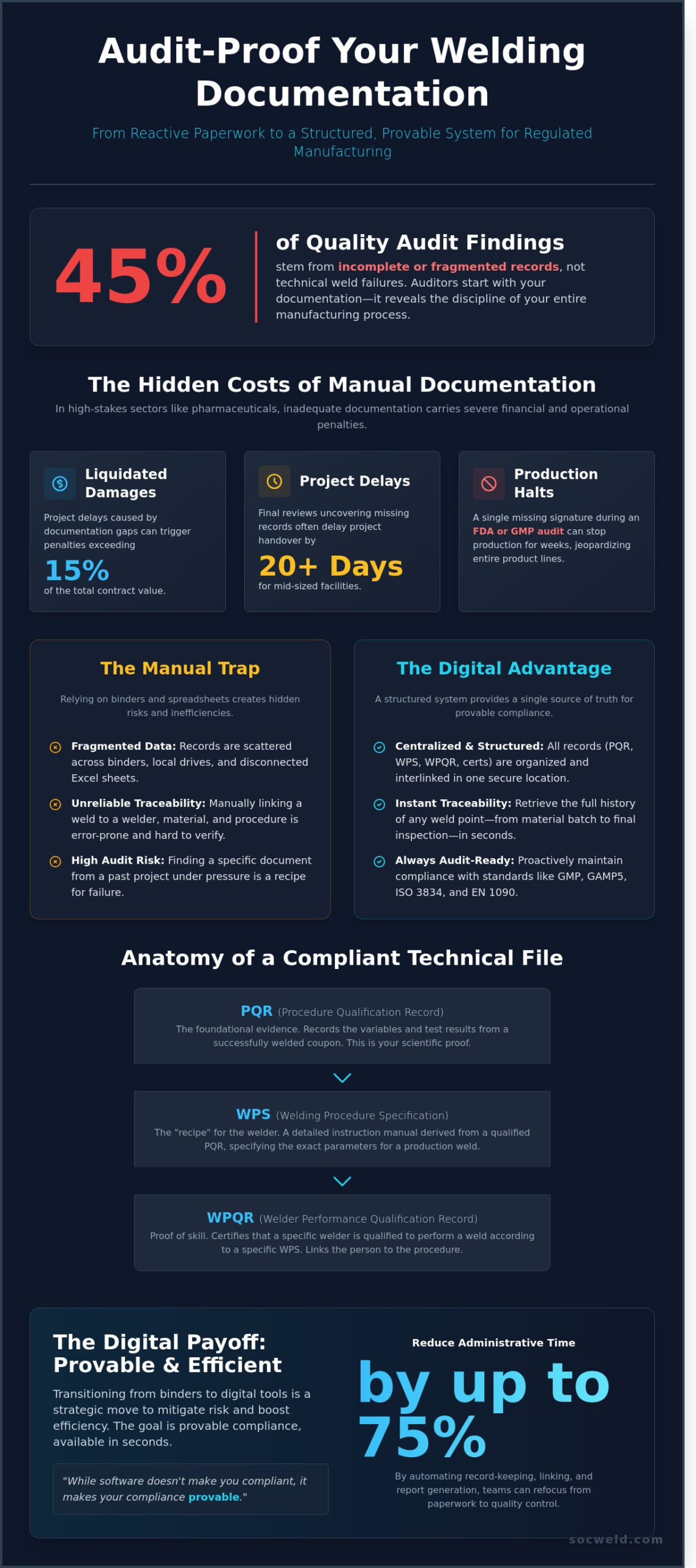
A 2023 industry survey revealed that nearly 45% of quality audit findings in sterile manufacturing stem from incomplete or fragmented records rather than technical weld failures. You likely know the frustration of discovering a missing welder certificate or an illegible manual log only when an auditor is standing in your facility. Managing welding documentation for manufacturers in the pharmaceutical sector often feels like a losing battle against endless binders and disconnected Excel sheets.
It’s a high-stakes environment where Good Manufacturing Practice (GMP) standards, which require documented proof that manufacturing processes are consistently controlled, dictate every move. This guide provides a strategic framework to structure your records so they support compliance with FDA requirements and GAMP5. GAMP5 provides a risk-based approach for compliant GxP computerized systems to ensure data reliability and integrity. You’ll learn how to move from reactive paperwork to a structured, auditable system that provides provable traceability for every weld point. We’ll examine how digital tools support a more disciplined approach, helping you reduce administrative overhead while ensuring your records remain audit-ready. While software doesn’t make you compliant, it makes your compliance provable.
Key Takeaways
- Understand why documentation is the primary deliverable in regulated environments and how shop floor activity is impacted by GMP. Good Manufacturing Practice (GMP) refers to the systems ensuring products are consistently produced and controlled, directly dictating how documentation and traceability must be handled during audits.
- Identify the core components of a technical welding file, including the essential hierarchy of PQR, WPS, and WPQR required for ISO 3834 and EN 1090.
- Recognize the hidden audit risks of using Excel and manual systems for **welding documentation for manufacturers**, which often lead to fragmented data and unreliable traceability.
- Learn best practices for organizing digital technical files and implementing standardized naming conventions to ensure all records remain structured and auditable.
- Explore a pragmatic approach to transitioning from binders to digital tools, which supports compliance and can reduce administrative time by up to 75%.
The Strategic Role of Welding Documentation in Regulated Manufacturing
In high-stakes sectors like pharmaceutical production or offshore wind power, the physical weld is only half of the required deliverable. The other half is the data that proves it was done correctly. For many organizations, welding documentation for manufacturers has evolved from a back-office administrative task into a critical strategic asset. If you’re building a bioreactor or a high-pressure piping system, a perfect weld without a corresponding material certificate or welder qualification is, legally and commercially, a non-existent weld.
The shift from simply “completing paperwork” to “maintaining an auditable state” is what separates top-tier manufacturers from the rest. It’s about ensuring that every joint is defensible under scrutiny. When records are fragmented, the project faces more than just technical issues; it faces financial ones. Inadequate documentation is a primary driver of project delays, often leading to liquidated damages that can exceed 15% of the total contract value.
Understanding the GMP and FDA Context
Good Manufacturing Practice (GMP) is a quality system ensuring products are consistently produced and controlled according to strict standards. In a pharmaceutical context, the FDA (Food and Drug Administration) requires total traceability for any equipment that contacts the product. This means every joint must be linked to a specific welder, a qualified procedure, and a batch-tracked filler material. Additionally, GAMP5 provides a risk-based approach to compliant GxP computerized systems, focusing on the documentation and validation of any software used to manage these records. A single missing signature in the technical file during a facility audit can halt production for weeks. Industry data suggests that documentation gaps found during final reviews often delay project handover by 20 days or more for mid-sized facilities.
Beyond the Weld: Documentation as a Quality Asset
Quality Managers in regulated environments rarely start their review by looking at the shop floor. They start with the documentation. They prioritize the technical file because it reveals the discipline of the manufacturing process. A structured approach to welding documentation for manufacturers shifts the focus to risk mitigation. It ensures that when an auditor asks for a specific WPS or NDT report from a project completed two years ago, it’s available in seconds.
- Documentation discipline reflects overall manufacturing excellence.
- Technical files serve as the primary evidence for ISO 3834 and EN 1090 compliance.
- Digital welding documentation software supports compliance by providing structured, auditable records.
Reframing documentation as a quality asset rather than a chore reduces the likelihood of expensive rework. It’s a proactive strategy. By maintaining a clean, organized record from the first weld, you protect the organization from the financial risks of failed audits and uncertified equipment.
Essential Components of a Technical Welding File for Manufacturers
A technical welding file is more than a binder of certificates; it’s the primary evidence of quality during a regulatory audit. For companies operating under GMP (Good Manufacturing Practice), which is a system for ensuring products are consistently produced and controlled according to quality standards, this file must be impeccable. In these environments, the FDA (Food and Drug Administration) requires comprehensive records to verify that manufacturing processes don’t compromise product safety. A missing signature or an expired certificate can halt production or lead to costly non-conformance reports.
Robust welding documentation for manufacturers relies on a clear hierarchy of procedures and meticulous material tracking. This documentation provides the visibility required to satisfy ISO 3834 and EN 1090 standards. Without a structured approach, the final closeout package becomes a bottleneck that delays project delivery and payment.
Procedure Qualification and Specifications
The PQR (Procedure Qualification Record) is the scientific foundation of your technical file. It records the actual variables used during a test weld and the subsequent lab results. You can’t have a valid WPS (Welding Procedure Specification) without a supporting PQR. The WPS acts as the instruction manual for the welder, detailing parameters like voltage, travel speed, and filler metal.
Mistakes here are frequent. A 2023 analysis of manufacturing audits found that 14% of non-conformances involve a WPS being used outside its qualified range. Common errors include using a procedure for a material thickness or pipe diameter that the PQR doesn’t cover. Professionals must ensure the WPS is physically available to the welder on the shop floor, not just filed in a distant office.
Welder Qualifications and Traceability
Managing Welder Performance Qualification Records (WPQR) is a constant administrative challenge. You must prove that only certified personnel performed the work. This requires tracking the 6-month revalidation intervals for every welder. In facilities with more than 25 operators, manual tracking through spreadsheets often leads to a 18% higher risk of certification lapses.
True traceability means linking every weld point on a drawing to a specific welder and their unique stamp. This link must be supported by:
- Material Test Reports (MTRs) for the base metals.
- Consumable certificates for electrodes or shielding gases.
- NDT (Non-Destructive Testing) reports, such as X-ray or ultrasonic tests, for the final inspection.
Using digital welding documentation tools helps structure this evidence, making it easier to provide a transparent audit trail. This approach ensures that when a quality manager reviews the final package, every weld is accounted for and verified against the project specifications. The goal is to move away from fragmented records and toward a cohesive, auditable state where compliance is easily provable.
The Risks of Manual Documentation Systems in High-Stakes Audits
Excel spreadsheets represent the most significant hidden risk in a modern welding department. While these files are easy to create, they lack the structural integrity required for GMP compliance. GMP, or Good Manufacturing Practice, refers to the minimum standards that a medicines manufacturer must meet in their production processes to ensure products are high quality and safe. In this environment, fragmented traceability is a liability. When data exists in three separate locations—paper binders, local drives, and email threads—the risk of a documentation gap increases exponentially. This fragmentation turns project closeout into an administrative black hole that sucks up time and resources.
The Spreadsheet Failure Mode
Spreadsheets inherently lack the version control and audit trails required for GAMP5 compliance. GAMP5 is a set of guidelines for manufacturers and users of automated systems in the pharmaceutical industry, focusing on a risk-based approach to compliant GxP computerized systems. Because manual files are easily editable without a permanent record of changes, they can’t guarantee data integrity. If a quality manager can’t prove who modified a weld ID or when a heat number was entered, the entire log may be deemed unreliable during an inspection. Manual entry also leads to “copy-paste” errors that can invalidate weeks of work. Industrial data entry studies show that manual systems often suffer from a 12% error rate, which is unacceptable in high-stakes manufacturing.
Audit Anxiety and the Search for Missing Records
The “man-hour drain” of preparing for a quality inspection is a direct result of manual systems. Many organizations report spending over 80 man-hours just consolidating paper binders for a single project closeout. This administrative burden creates a lack of visibility where Project Managers can’t identify risks early. If a Material Test Report (MTR) is missing or a welder’s certificate expired 48 hours before a critical joint was completed, a manual system won’t flag the issue until the audit has already begun. Using digital welding documentation for manufacturers supports compliance by providing a structured framework for evidence. It doesn’t replace the need for technical discipline, but it ensures that records are retrievable when an auditor is standing in the room. Without this structure, the cost of a failed audit or a delayed project release can far exceed the investment in proper documentation tools.
Structuring Your Documentation for Provable Compliance
Organizing a digital technical file requires more than just a cloud folder; it demands a logical architecture that mirrors your physical production. For effective welding documentation for manufacturers, you should implement a standardized naming convention for all WPS and PQR files. A common format is [Project ID]_[Material Group]_[Weld Type]. This allows a Quality Manager to locate a specific procedure in under 30 seconds during a spot check. Consistency across multiple production sites is only possible when every team uses the same digital structure. Without this, your traceability becomes fragmented, increasing the risk of audit findings.
The distinction between a “live” welding log and a “post-mortem” log is critical. A live log is updated as work progresses, ensuring data is captured while the details are fresh. A post-mortem log is a retrospective reconstruction, often compiled weeks after the project ends. In a 2023 review of pharmaceutical piping projects, 65% of documentation gaps were traced back to retrospective logging. Relying on memory or loose notes leads to errors that are difficult to correct once the system is closed and insulated. It’s better to capture data immediately than to hunt for missing signatures during a final review.
Data Integrity and Traceability Standards
Applying ALCOA+ principles is mandatory in GMP-regulated environments. GMP (Good Manufacturing Practice) is the regulatory framework ensuring products are consistently produced and controlled according to quality standards. To meet these, welding logs must be Attributable, Legible, Contemporaneous, Original, and Accurate. When structuring evidence for ISO 3834-2 audits, every weld seam in pharmaceutical piping must have a unique identifier. This ID links the physical weld to the specific welder, the WPS used, and the NDT results, creating a clear chain of custody.
The Role of Digital Tools in Supporting Compliance
Digital platforms support compliance by providing structured, auditable records that are easy to retrieve. However, software doesn’t guarantee compliance or physically enforce actions on the shop floor. It doesn’t prevent an uncertified welder from picking up a torch; that remains a management responsibility. Software provides visibility into the process, highlighting missing records before they become a liability. Many organizations report up to 75% time savings on documentation management when moving away from paper binders. This efficiency allows Welding Coordinators to focus on quality rather than chasing paperwork.
To reduce the administrative burden of these tasks while maintaining high standards, you can book a demo of SOCWeld to see how structured digital logs support your audit readiness.
Transitioning to Digital Welding Documentation: A Pragmatic Approach
Many manufacturers still rely on physical binders and fragmented Excel sheets to manage their quality records. This manual approach creates a heavy administrative burden and increases the risk of documentation gaps. Moving to a digital platform allows organizations to centralize their welding documentation for manufacturers, replacing paper logs with a structured database. Many organizations report that they save up to 75% of the time previously spent on manual data entry and document retrieval.
Software isn’t a shortcut for a lack of process. It’s the natural conclusion to a disciplined quality system. The first steps in moving from manual logs to a digital platform involve auditing your current workflow. Identify where the bottlenecks occur. Often, these are found in tracking expired welder certificates or compiling final documentation packages for clients. Transitioning to a digital system requires a clear mapping of these existing processes into a structured digital environment.
Evaluating Digital Documentation Platforms
When you evaluate a platform, focus on features that support certificate management, automated log generation, and a real-time overview of project status. These tools must align with GMP requirements. Good Manufacturing Practice (GMP) ensures products are consistently produced and controlled according to quality standards, demanding rigorous documentation to prove every step was followed. Similarly, the FDA requires detailed, retrievable records to ensure public safety and product efficacy. Your software should act as an advisory partner, prompting users for mandatory data according to ISO 3834 or EN 1090 standards.
User experience for the welder is just as important as the reporting for the manager. If the interface is cumbersome, data entry becomes a chore, leading to errors. A practical tool provides a clear interface for the shop floor while delivering high-level visibility for the Quality Manager. It should follow GAMP5 principles, which is a risk-based approach to compliant computerized systems, focusing on ensuring software is fit for its intended use through structured validation.
A Sober Conclusion on Discipline and Risk
Software doesn’t make you compliant. It makes compliance provable. Quality remains a human discipline that requires constant oversight. While digital tools provide structured, auditable records and reduce the risk of missing data, they don’t physically control the welding activity or replace the expertise of a Welding Coordinator. They’re tools to support the evidence of your competence.
Is your current documentation system a proof of quality, or a liability waiting to be audited? If you can’t produce a full traceability report in minutes, you’re carrying unnecessary risk. See how SOCWeld supports structured, auditable records to help manage that risk effectively.
Strengthening Your Audit Defense
A technical welding file isn’t just a collection of papers; it’s a strategic asset for GMP compliance. Manual systems often fail under the pressure of high-stakes audits because they lack the necessary data integrity. Leading manufacturers in the pharma and maritime sectors have already moved away from fragmented spreadsheets toward more structured approaches. By organizing your welding documentation for manufacturers around ISO 3834 and EN 1090, you ensure that traceability is a constant state rather than a last-minute scramble.
Software doesn’t make you compliant, but it makes your compliance provable. Many organizations report saving up to 75% of their time by digitizing these workflows. This shift allows Welding Coordinators to focus on technical oversight while the system maintains the documentation structure required for audit readiness. It’s a pragmatic investment in operational discipline that reduces risk and improves efficiency across the production floor.
The core principle is universal: relying on certified specialists and maintaining clear records mitigates risk. This philosophy extends beyond processes to the quality of components used in production machinery. For manufacturers seeking reliable conveyor components and plastic guide rails that uphold these high standards, you can learn more about Slideways, Inc..
Book a demo to see how SOCWeld supports your compliance journey. Taking control of your documentation today ensures you’re prepared for whatever the next audit brings.
Frequently Asked Questions
Does welding documentation software guarantee ISO 3834 compliance?
No, software doesn’t guarantee compliance with ISO 3834. It’s a support tool designed to help you structure the evidence required for an audit. Compliance is an auditable state that depends on your team’s adherence to established procedures. While users often report a 40% reduction in audit preparation time, the software provides visibility rather than physical enforcement of the standard’s requirements.
What are the most common documentation errors found in pharmaceutical audits?
Audit data indicates that 25% of manual logs contain missing signatures or retrospective entries. In a GMP environment, where Good Manufacturing Practice ensures products are consistently produced to quality standards, these gaps are high-risk. Other frequent issues include using welders whose certificates expired 48 hours prior or failing to link material heat numbers to specific joint identifiers in the final data book.
How long should manufacturers retain welding documentation for GMP projects?
You’ll typically need to retain records for at least 5 years after the product shelf life or 15 years for capital equipment. FDA regulations, which involve the Food and Drug Administration’s oversight of medical product safety, require that these records remain legible and accessible. Storing paper binders for 15 years introduces a 12% risk of document degradation or loss, making digital archives a more stable alternative for long-term storage.
Can digital welding logs be used for EN 1090 certified projects?
Yes, digital logs are acceptable for EN 1090 projects provided they maintain clear traceability for the Notified Body. The software helps you organize WPS and welder qualifications into a structured format for Execution Class 2 or 3 projects. It doesn’t grant the certification itself; it simply makes the evidence of your compliance easier to navigate during a factory production control assessment.
What is the difference between a welding log and a technical file?
A welding log is a specific record of individual weld points, while a technical file is the complete dossier required for project handover. The log is just one component of the broader file. In complex welding documentation for manufacturers, the technical file also incorporates NDT reports, design calculations, and material certificates to prove the entire assembly meets the specified engineering standards.
How does digital documentation support traceability in large-scale maritime projects?
Digital systems manage the massive volume of data generated in maritime builds, which can involve over 15,000 individual weld points. By utilizing digital welding documentation for manufacturers, you can link every joint to a specific welder and batch of filler metal in seconds. This approach reduces the time spent compiling final documentation by 60% compared to manual spreadsheet tracking and paper filing.
Is software required to manage welder certificates effectively?
Software isn’t a legal requirement, but it’s a practical necessity for shops managing more than 12 welders. Manual tracking systems result in a 15% higher rate of expired certificates being overlooked during active projects. Digital tools provide the visibility needed to schedule renewals, though they don’t physically prevent an uncertified person from working. The responsibility for certificate validity remains with the Welding Coordinator.
What does ‘contemporaneous’ mean in the context of a welding log?
Contemporaneous means the record was created at the moment the work was performed. In GMP audits, backfilling logs several days after the welding is finished is considered a major non-conformance. This aligns with GAMP5, which provides a framework for compliant GxP computerized systems, stating that data must be recorded immediately to ensure its integrity and reliability throughout the project lifecycle.
Related Resources
Ready to modernize your welding documentation? Start with a free online assessment to see where your process stands today.