

Welding Documentation for Offshore Industry: Managing Risk and Compliance
In the offshore sector, a weld is only as strong as the documentation that supports it. You know that a single documentation gap can lead to audit failure or, worse, costly rework on a critical asset. Managing welding documentation for offshore industry projects often feels like a constant battle against administrative decay, especially when you’re tracking hundreds of welder certificates and WPS records across global sites using fragmented spreadsheets.
We understand the pressure of maintaining audit readiness under the latest standards, such as the July 2026 Polish Register of Shipping updates or revised IACS Unified Requirements. It’s a common challenge for Welding Coordinators and Quality Managers who must provide clear evidence for compliance bodies like DNV, ABS, or LR. This guide offers an expert framework for structuring your offshore welding records to ensure they’re always audit-ready and support long-term asset safety.
We’ll look at practical ways to centralize traceability and align your technical files with ISO 3834 and EN 1090 standards. By moving toward a more structured system, you can reduce the administrative burden and focus on the technical integrity of your offshore operations.
Key Takeaways
- Understand the specific documentation rigor required by classification bodies like DNV, ABS, and LR to maintain offshore asset integrity.
- Learn to structure WPS, PQR, and WQR records as a cohesive technical file that provides clear evidence of procedure and personnel qualification.
- Identify high-risk documentation gaps, such as mismatched heat numbers or expired certificates, that frequently lead to audit non-compliance.
- Establish a reliable ‘Chain of Evidence’ by linking every joint to a qualified procedure, a specific welder, and a verified material batch.
- Evaluate how digital systems for welding documentation for offshore industry support compliance by providing the structure needed to make records auditable and transparent.
The Critical Role of Documentation in Offshore Welding Integrity
Offshore welding isn’t just a physical process; it’s an information process. In high-stakes environments like deep-water platforms or offshore wind substructures, the physical weld is only as valid as its paper trail. We define welding documentation for offshore industry projects as the structured, verifiable evidence of material provenance, procedure validity, and personnel qualification. Without this data, a structural joint doesn’t exist in the eyes of a regulator. Documentation is the technical biography of your asset, and any missing chapters create structural risk.
Classification societies like DNV, ABS, and LR demand a level of rigor that far exceeds typical onshore construction. This isn’t bureaucracy for its own sake. In subsea or splash-zone environments, fatigue and corrosion are relentless. Documentation discipline is your first line of defense against structural failure. Interestingly, project delays in this sector are rarely caused by physical weld defects. They’re caused by documentation gaps. If you can’t prove a welder was qualified on the day the joint was made, the work is technically non-compliant, regardless of its physical quality.
Defining the Auditable State of Compliance
Compliance isn’t a static folder you pull off a shelf during an annual review. It’s a continuous auditable state. You must be ready to demonstrate that every action taken on the shop floor or the deck aligns with the approved Welding Procedure Specification (WPS). This level of oversight is comparable to Good Manufacturing Practice (GMP), a system that ensures products are consistently produced and controlled according to quality standards to minimize risks. In an offshore context, ISO 3834 provides this essential framework, acting as a roadmap for managing the complex variables of fusion welding.
While third-party certification confirms your facility’s capability, internal quality management ensures that capability is applied to every single weld. This requires a mindset similar to those following FDA requirements, where the Food and Drug Administration mandates that records must be accurate, legible, and contemporaneous to ensure safety. Software tools can support this state by providing visibility, but they don’t create compliance; they merely make your existing discipline provable to an inspector.
The Cost of Documentation Failures
Documentation failures are expensive. If a material certificate is missing, you can’t simply “check it later” when the asset is already being mobilized. You’re often forced into costly non-destructive testing (NDT) re-runs or even destructive testing to verify material properties. These errors hit your final project handover and payment milestones directly. Many organizations find that “fixing it later” is a failed strategy in offshore logistics.
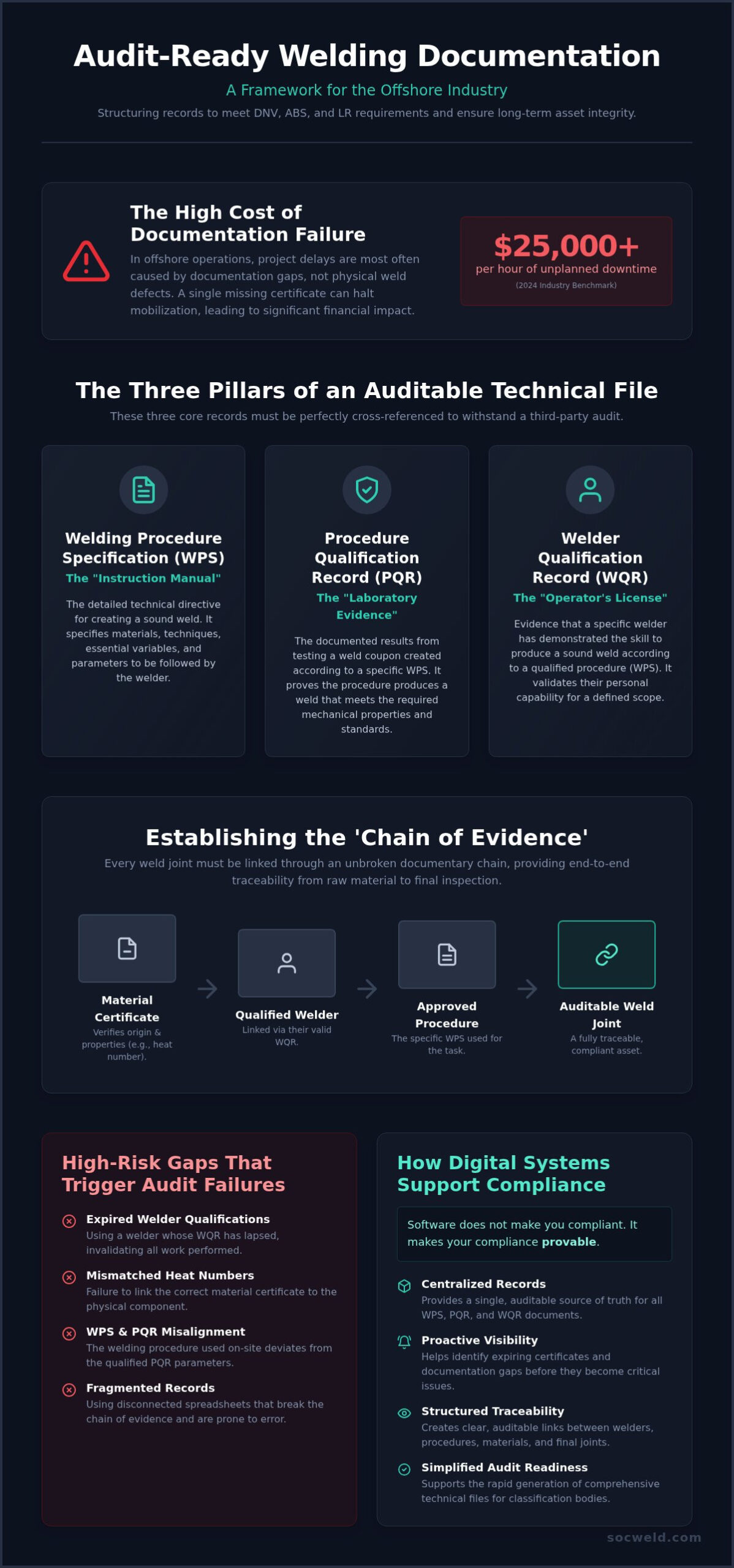
The financial impact of a vessel standing idle while you hunt for a lost heat number can be devastating. According to 2024 industry benchmarks, a single hour of unplanned downtime in offshore operations can cost upwards of $25,000. Discipline in your records isn’t just about safety; it’s about protecting your margin. When documentation is fragmented across spreadsheets, the risk of these errors increases. A structured approach to record-keeping ensures that the “Chain of Evidence” remains unbroken from the first bead to the final handover.
Core Components of Offshore Welding Records: WPS, PQR, and WQR
Building a technical file for offshore assets requires a modular approach to data. The foundation of this system consists of three primary documents: the Welding Procedure Specification (WPS), the Procedure Qualification Record (PQR), and the Welder Qualification Record (WQR). Think of the WPS as the technical instruction for the joint, while the PQR serves as the laboratory evidence that the instruction produces a sound weld. The WQR is the proof that the individual welder possesses the skill to execute that specific instruction. In the high-pressure environment of welding documentation for offshore industry projects, these records must be cross-referenced perfectly to withstand a third-party audit.
Traceability also extends to the physical materials used. Material Certificates (3.1 or 3.2) are non-negotiable for ensuring that the steel in your asset matches the design specifications. When operating on the Outer Continental Shelf, strict adherence to federal welding procedures is mandatory to ensure safety and environmental protection. Missing a single heat number or a batch identifier for a consumable can invalidate an entire section of the structure, leading to significant delays during the final handover.
Structuring a Robust Documentation Package
A common mistake in large-scale projects is creating a new WPS for every minor variation, which leads to administrative bloat. Instead, experienced coordinators link a single PQR to multiple WPS documents where the essential variables allow. Your records must capture specific data points for every joint, including heat numbers, consumable batches, and NDT report references. Maintaining a digital welding log allows you to bridge the gap between office-based planning and site-based execution, providing a structured record that satisfies both internal QA and external inspectors. Many organizations find that having a live overview of welding projects helps identify documentation gaps before they become audit liabilities.
Managing Standards: ISO 3834 and EN 1090
For offshore structural work, the intersection of ISO 3834-2 and EN 1090 defines the documentation rigor. ISO 3834-2 sets the comprehensive quality requirements, while EN 1090 influences how execution classes are documented in maritime construction. This structured approach is similar to maintaining a Technical File in a GMP environment. GMP (Good Manufacturing Practice) is a system for ensuring that products are consistently produced and controlled according to quality standards, which in welding requires meticulous, contemporaneous record-keeping.
The Welding Coordinator (IWS/IWE) is responsible for ensuring this evidence is structured correctly. This isn’t just about collecting papers; it’s about creating an auditable state. Software tools can support this process by centralizing certificates and automating log generation, but the coordinator must still exercise technical oversight to ensure the data is accurate. By aligning your documentation structure with these international standards, you make the compliance process provable rather than just aspirational.
Common Documentation Gaps that Compromise Offshore Audits
Managing welding documentation for offshore industry projects isn’t just about knowing the codes; it’s about managing the sheer volume of data they generate. Even the most experienced coordinators fall into predictable administrative traps. The most frequent cause of audit failure isn’t a bad weld, but an expired welder certificate. In global projects where crews move between jurisdictions, tracking these dates across different certifying bodies is a significant risk. If a welder’s qualification lapsed just 48 hours before the joint was made, that work is technically non-compliant.
Traceability gaps are equally common. You’ll often find that heat numbers recorded on a drawing don’t match the material certificates in the final data book. This inconsistency suggests a breakdown in the ‘Chain of Evidence.’ When working with high-integrity standards like the Underwater Welding Code, these discrepancies trigger immediate red flags for inspectors. There’s also the ‘Signature Trap’. These are logs signed off weeks after the work was completed. This suggests a lack of real-time oversight. In a GMP environment, this is a major non-conformance. GMP (Good Manufacturing Practice) is a regulatory framework that ensures products are consistently produced according to quality standards; it requires contemporaneous documentation to ensure every step of production is traceable and auditable.
The Failure of the Spreadsheet System
Relying on a manual welding documentation spreadsheet for welding documentation for offshore industry work often leads to fragmented data. Spreadsheets feel familiar, but they lack the version control required for high-stakes offshore projects. They’re prone to manual transcription errors, especially when moving NDT results from a technician’s report into a master log. A single mistyped character can invalidate a record. This creates a false sense of security. You think you have a system, but you actually have a collection of disconnected data points that won’t survive a deep-dive audit.
Preparing for Rigorous Third-Party Inspections
Inspectors from ABS, DNV, or Lloyd’s Register are trained to spot these weaknesses quickly. In the first 10 minutes of an audit, they’ll often ask for a random record from six months ago. If you can’t retrieve it instantly, they’ll assume your entire system is compromised. Instant retrieval is the hallmark of an auditable state. If you can’t find the record, it doesn’t exist. You shouldn’t wait for the inspector to arrive to find your gaps. Proactive discipline means identifying missing signatures or expiring certificates long before the final project handover. Addressing these issues early protects your project milestones and ensures your asset’s integrity is provable from day one.
Establishing Traceability and Discipline in Offshore Projects
Traceability in the offshore sector is often misunderstood. It isn’t a passive collection of certificates; it’s the active linking of every weld to a specific procedure, a qualified person, and a verified material batch. This “Chain of Evidence” is what a Welding Coordinator must maintain throughout the project lifecycle. When field changes or repairs occur, you can’t simply bypass the protocol. A repair isn’t just a correction; it’s a new technical event that requires its own documentation trail and, often, a specific repair procedure. Breaking the record during a field change is one of the fastest ways to invalidate an entire data book.
It’s important to distinguish between documentation-focused traceability and real-time physical monitoring. While some advanced equipment tracks arc parameters, the primary risk in welding documentation for offshore industry projects lies in the records themselves. If the technical file is incomplete or inconsistent, the physical integrity of the weld is legally irrelevant during an audit. You’re not just proving the weld is strong; you’re proving it was made according to the rules set by DNV or ABS.
The Role of Identifiers and Records
Mapping documentation to physical structures requires unique weld identifiers. Every joint on a drawing must have a corresponding entry in the technical file. This discipline extends to consumables. You must track electrode lot numbers and wire batches to specific joints to ensure that, in the event of a material failure, the scope of the risk is contained. This level of detail is essential for maintaining welding compliance. Without these identifiers, your traceability is fragmented and won’t survive a deep-dive inspection from a classification society.
Discipline Over Technology
No system works without a culture of administrative discipline. Whether you use paper or digital tools, the quality of the data depends on the people entering it. Training site personnel to understand the value of accurate data entry is critical. They must realize that a missing heat number is just as dangerous to the project’s timeline as a physical defect. Documentation must happen alongside the welding activity, not weeks later when memories have faded and logs are signed in a rush.
This approach mirrors the principles of Good Manufacturing Practice (GMP). GMP is a system for ensuring that products are consistently produced and controlled according to quality standards, which requires that documentation is contemporaneous and accurate to prevent audit failures. When using automated systems, many organizations look to GAMP5 guidelines. GAMP5 (Good Automated Manufacturing Practice) provides a risk-based approach to compliant computerized systems, ensuring that software tools are fit for purpose and properly validated. To maintain this level of oversight without the administrative burden, you can use a digital welding documentation platform to centralize your records and keep your projects audit-ready.
Supporting Offshore Compliance with Digital Documentation Tools
Managing welding documentation for offshore industry projects at scale requires more than just administrative discipline; it requires a structural framework that manual systems cannot provide. Digital platforms serve as a support tool by centralizing the “Chain of Evidence” discussed in previous sections. These systems reduce the risk of using uncertified welders or expired procedures by providing automated alerts and visibility. Instead of discovering a lapsed certificate during a DNV or ABS audit, a digital overview allows you to identify and resolve documentation gaps in real-time. This proactive approach is the foundation of a modern, paperless QA/QC process that improves both project efficiency and transparency for all stakeholders.
Transitioning to a digital workflow supports compliance by ensuring that data is recorded in a structured, auditable format. This is particularly relevant for professionals accustomed to GMP (Good Manufacturing Practice) environments. GMP is a system for ensuring that products are consistently produced and controlled according to quality standards; in the context of welding, it mandates that every record is accurate, contemporaneous, and fully traceable. By using a digital system, you ensure that your records satisfy these rigorous standards without the physical clutter of traditional binders.
Structuring Auditable Records Digitally
Software helps structure evidence for ISO 3834 and EN 1090 audits by creating a logical link between procedures, personnel, and material batches. Instead of manually transcribing data into a master log, digital tools allow for the automated generation of welding logs from validated data sets. This reduces the risk of transcription errors that often trigger non-conformances. When an inspector from Lloyd’s Register or a similar body arrives, you can provide a clear, searchable digital package. This immediate retrieval demonstrates a level of control that physical binders rarely achieve. It shifts the audit from a stressful search for missing papers to a straightforward verification of a well-organized system.
Transitioning from Manual to Digital Workflows
The transition from manual spreadsheets to digital platforms is often driven by a need for better resource management. Many organizations report significant time savings when they automate the administrative hours previously spent on manual log generation and certificate tracking. For a Welding Coordinator managing multiple global projects, these efficiencies allow for a focus on technical oversight rather than data entry. This transition is often managed using GAMP5 principles. GAMP5 (Good Automated Manufacturing Practice) is a risk-based approach to compliant computerized systems that focuses on ensuring software is fit for purpose through proper validation and lifecycle management.
However, it’s vital to maintain a sober perspective on technology. Software is a support tool, not a substitute for expertise. It provides the visibility and structure needed to manage complex data, but compliance still requires expert oversight and a culture of discipline. Digital tools make your records auditable, but the quality of the technical decisions remains the responsibility of the Welding Coordinator. Ultimately, software does not make you compliant. It makes compliance provable. As you look at your current project, ask yourself: if an inspector walked in today, could you prove the integrity of every joint in under ten minutes?
Strengthening the Auditable State of Your Offshore Projects
Managing welding documentation for offshore industry projects is a continuous commitment to technical discipline. It’s about structuring technical files around the core components of WPS, PQR, and WQR to move from administrative uncertainty to provable compliance. Identifying gaps like expired certificates or inconsistent heat numbers before an inspector arrives protects project timelines and prevents costly downtime.
Digital systems provide the necessary structure to manage global projects; however, they’re most effective when paired with expert oversight and a culture of real-time record-keeping. This approach ensures your “Chain of Evidence” remains unbroken from fabrication to decommissioning. See how SOCWeld supports structured, auditable welding records to support your ISO 3834 and EN 1090 compliance and benefit from an expert-led digital transition that reduces administrative risk.
Establishing this level of control ensures your assets remain safe and your operations remain profitable. With the right discipline, you can turn compliance from a recurring hurdle into a reliable competitive advantage. Is your documentation system ready for the next audit?
Frequently Asked Questions
Does welding software guarantee compliance with offshore standards?
No software can guarantee compliance with offshore standards. Compliance is an auditable state of readiness achieved through expert oversight and professional discipline. Digital tools act as a support system by providing structured, auditable records that make your existing quality management processes easier to prove during an inspection. Software provides visibility but doesn’t replace the technical responsibility of the Welding Coordinator.
What are the most common documentation errors found in offshore audits?
The most frequent errors involve expired welder qualifications and inconsistent material traceability. Auditors often find that heat numbers on drawings don’t match the certificates in the final data book. Another common issue is the “Signature Trap,” where logs are signed weeks after the work is finished. This suggests a lack of real-time oversight and frequently leads to audit failure in high-stakes environments.
How does ISO 3834-2 apply to offshore welding documentation?
ISO 3834-2 defines the comprehensive quality requirements for fusion welding. It acts as the primary framework for managing welding documentation for offshore industry projects. By following this standard, you ensure that every variable, from personnel qualifications to material batches, is documented in a way that satisfies international regulatory bodies and maintains the technical integrity of the asset.
Can digital welding logs be used for DNV or ABS certification?
Yes, digital welding logs are accepted by bodies like DNV and ABS as valid evidence for certification. These organizations prioritize the accuracy, legibility, and accessibility of the technical file. A structured digital system allows for the instant retrieval of records, which demonstrates high operational control. This is significantly more effective than searching through physical binders during a high-pressure third-party audit.
What is the difference between a PQR and a WPS in an offshore context?
A WPS is the technical instruction for the welder, while the PQR is the supporting evidence that the procedure is sound. In offshore projects, you must link every WPS to a qualified PQR. The PQR contains the results of laboratory testing that verify the procedure meets the required technical standards for the specific environmental conditions of the project.
How do I manage welder certificate expirations across multiple projects?
Managing expirations across global projects requires a centralized system rather than fragmented spreadsheets. Many organizations report significant time savings by using digital platforms that provide automated alerts for upcoming expiration dates. This proactive approach prevents the risk of using an uncertified welder, which is a major non-conformance in any auditable environment governed by international standards.
Does digital documentation track real-time welding parameters?
No, the scope of traceability in welding documentation for offshore industry software is strictly documentation-focused. It tracks records, certificates, and identifiers rather than real-time welding parameters or physical monitoring. This focus aligns with GMP (Good Manufacturing Practice), a regulatory framework ensuring products are consistently produced and controlled according to quality standards through contemporaneous record-keeping. Software makes this documentation provable and transparent.
Related Resources
Ready to modernize your welding documentation? Start with a free online assessment to see where your process stands today.